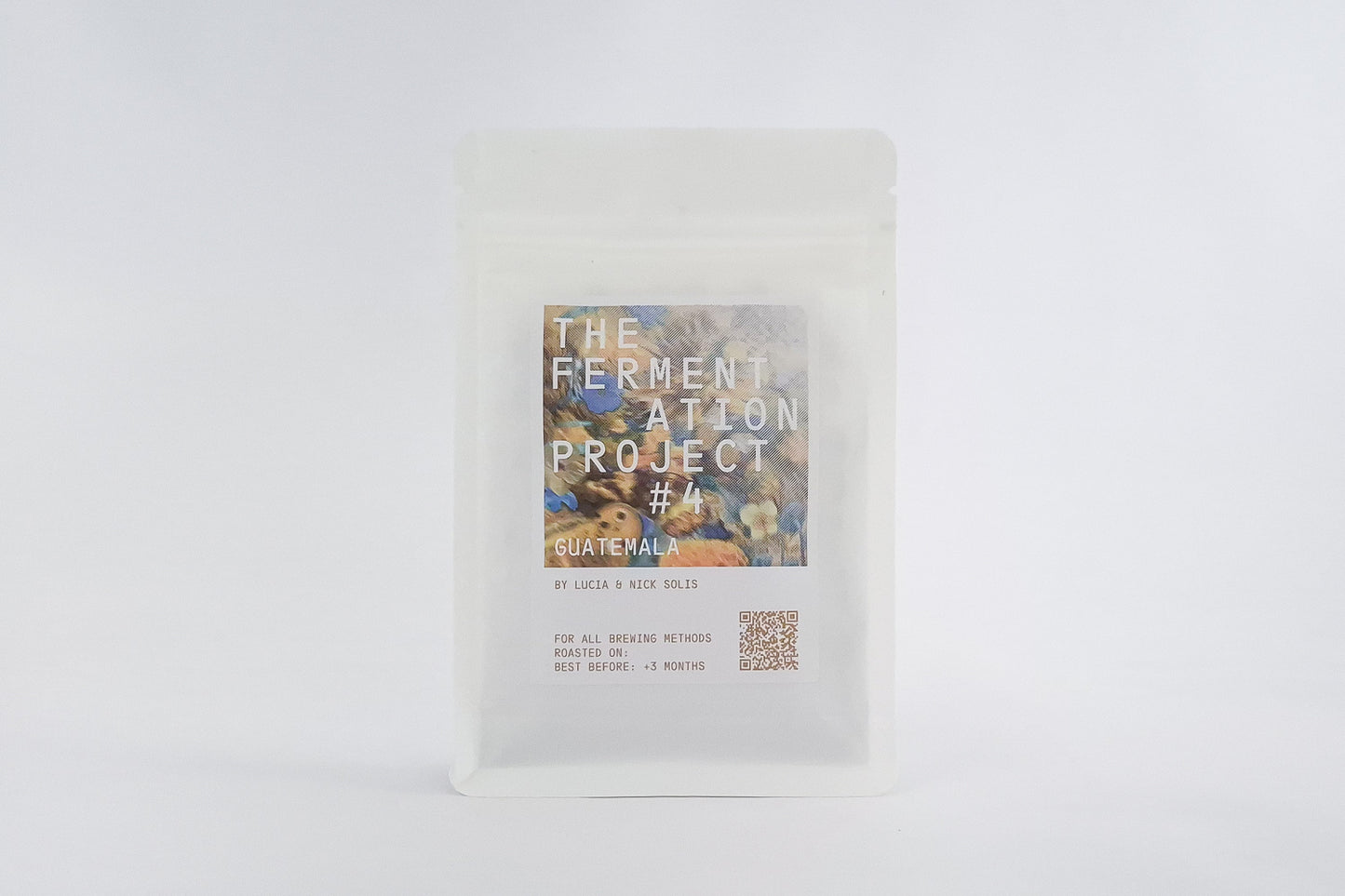
This coffee has sold out and is currently not in our offer. While we mostly work with the same producers and coffees every year, most of our coffees are part of our offer seasonally – usually for a couple of months each year.
What is The Fermentation Project?
Two personalities well known in the world of specialty coffee, Lucia Solis and James Hoffmann, have teamed up to create the Fermentation Project and reached out to roasters around the world to collectively compare how four different types of fermentation in coffee make a coffee taste different.
The coffee from Finca San Miguel Urias, the farm Lucia and Nick Solis manage in Guatemala, was processed mostly the same overall – but fermented four different ways. The green coffee was then distributed to roasters around the world, including us here at Drip, as part of a global project designed to bring these different fermentation approaches to as many coffee drinkers as possible.
Dispatching Schedule
This is a tasting set of 4 x 80 grams of coffee. We roast and ship the sets in a few batches, with an order deadline for each batch. Pre-orders are collected and all orders placed are shipped with the next batch – not immediately. May sell out before the deadline. Subject to availability and changes.
Please note if you order other products along with the tasting set:
For domestic orders, other products will usually be shipped separately before.
For international orders, other products will be held back and shipped later, along with the Fermentation Project on the shipping day outlined below.
Additional batches might be added if any stock will be left after the first two batches.
About the Coffee
All lots are mostly of the Caturra varietal, with some H1 and Bourbon inside. Each of these coffees is what's considered a washed coffee: The coffee cherries are floated when they arrive at the wet mill to sort out defects, pulped, and put into fermentation tanks submerged in water. All of them are fermented for approximately 48 hours – except for the mechanically demucilaged coffee that wasn't fermented. Next, they are washed or rinsed, before being sent to the patios where they are dried for 10–14 days with intermittent shade use to control temperatures.
The Fermentation
This tasting set's four lots each showcase a different fermentation method. Fermentation breaks down the mucilage, but it also affects what a coffee tastes like. The set is designed to be cupped together, each coffee side by side, exploring the question: How does fermentation actually shape a coffee's flavor profile? The following only describes, for each lot, the fermentation step, which is part of the post-harvest processing.
Mechanically Demucilaged
The mucilage – the sticky outer layer around the coffee seed – is stripped away using water and mechanical friction, via a specialized piece of equipment called a demucilaginator, or sometimes referred to as an Eco-Pulper. Many or most producers do not have this machine at their disposal. It makes it possible to process coffee without any fermentation taking place. Coffee processed using this machine is often referred to as semi-washed. This method is considered the control in this project.
Wild Fermentation
The coffee is submerged in a tank of water, where mucilage breakdown happens naturally through the wild microorganisms already present in the surrounding environment. No cultures are added. Because microbial populations shift with location, season, and even the specific wet mill, this method captures a kind of fermentation fingerprint unique to that place and moment, one that's inherently difficult to replicate exactly.
Lactobacillus Inoculated
Mucilage breakdown is driven by a specific dose of Lactobacillus bacteria added directly to the fermentation tank – a more designed fermentation so to speak. Using a specific, known strain, this method aims for a more consistent and predictable fermentation outcome, one that can be reproduced more reliably across batches.
Yeast Inoculated
Mucilage breakdown here is driven by a concentrated dose of yeast added directly into the fermentation tank. Similar to Lactobacillus Inoculated fermentation, but adding yeast instead of bacteria. The two methods have in common that both rely on a more designed fermentation instead of a spontaneous fermentation with the naturally occurring microbes.
About the Project
In the video below, James Hoffmann and Lucia Solis talk about fermentation in coffee and the different types of fermentation applied to the separate lots that are part of this project. A dedicated project site will be launched soon as well.
A global live tasting event will take place on October 3rd, 15:00 UK time (16:00 Swiss time). You can find all the information about this on the project website.
We paid an FOB price of $6.5/lb for this coffee, which is 325% of the Fairtrade minimum price. Find out what this means here.
Lucia & Nick Solis
Farm: Finca San Miguel Urias Producer: Lucia & Nick Solis Purchasing relationship: 1
year
Region: between Ciudad Vieja & San Miguel Dueñas, Antigua Valley
Altitude: 1460-1540 masl, 14.5°N
Finca San Miguel Urias is where Lucia and Nick Solis produce coffee. The farm is owned by Hector and Lilian Leal and operated under Rueda Farms. Lucia and Nick are the ones taking care of the operations every day.
Lucia, a wine specialist turned coffee farmer, has made herself a name in the world of specialty coffee with her highly recommendable podcast Making Coffee with Lucia Solis. She has since launched and collaborated on other podcasts and video series on coffee, particularly on fermentation in coffee. After nine years in Napa Valley's wine industry, she moved into coffee in 2014 and has since spent over a decade working internationally as a fermentation expert in coffee, partnering with more than 100 producers across 15+ countries. She helps producers see processing not as a fixed step but as a lever for adding value and lowering risk at the wet mill – simplifying protocols from fermentation to drying for greater consistency and control. Drawing on microbiology, she enables producers to achieve repeatable cup profiles even at coffee's most unpredictable production stage, always balancing scientific precision with practical, scalable solutions.
Choosing a selection results in a full page refresh.