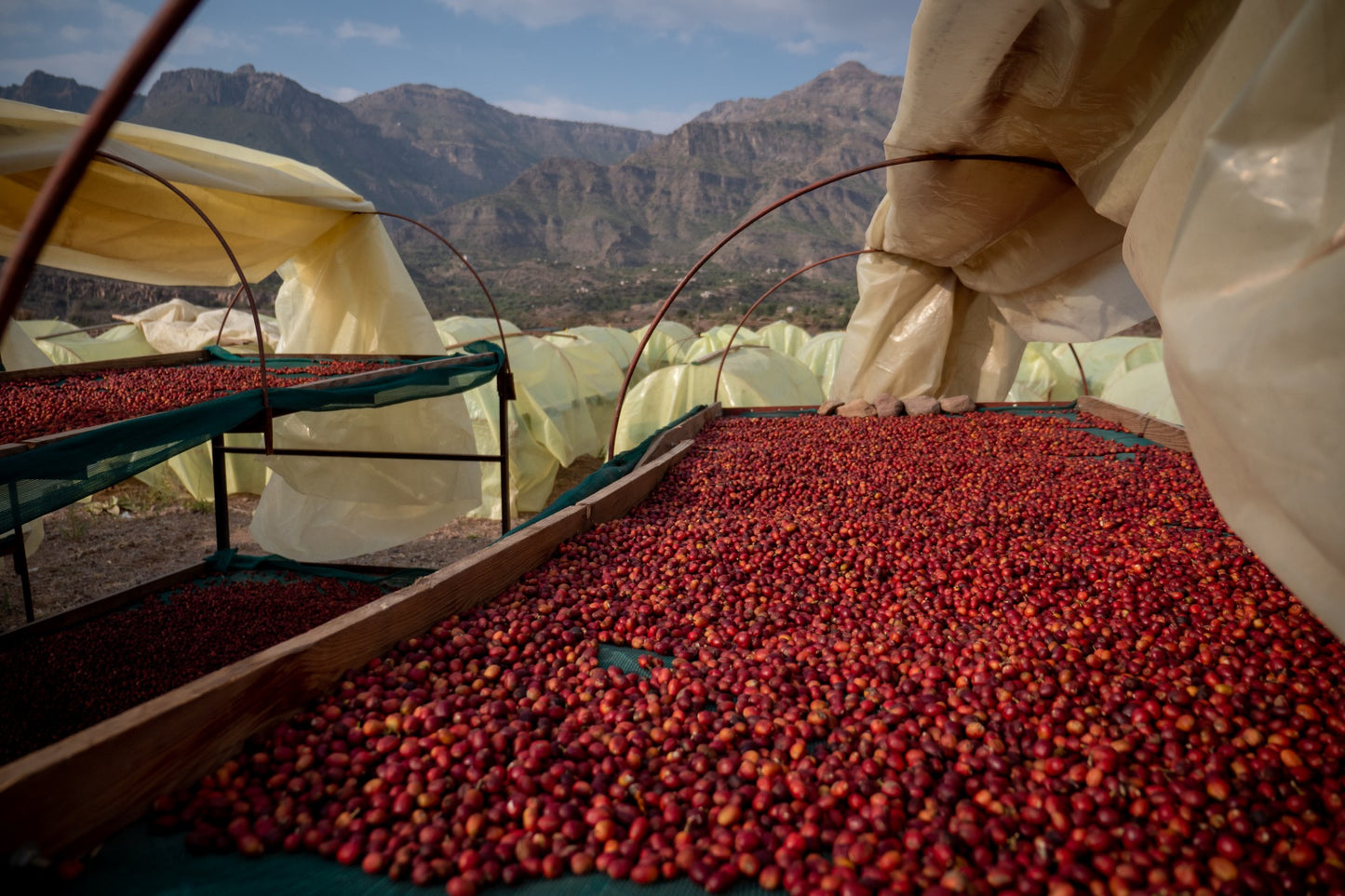
Did you know Yemen has one of the longest histories of coffee production, dating back to the 1400s? Extreme conditions marked by low rainfall and drastic temperature swings are typical for coffee production in Yemen. These conditions have undoubtedly shaped resilient landraces over 600 years, from the introduction of coffee in the 1400s to today.
Yemenia
Yemenia is a newly identified «mother varietal» within the species Coffea arabica, found exclusively in Yemen. This discovery represents a vast reservoir of untapped genetic diversity and future varieties with the potential to redefine the world of Arabica coffee for centuries. Yemenia was researched extensively the last few years by Qima Coffee. The project included Yemen's largest-ever genetic coffee survey, spanning over 25'000 square kilometres. Yemenia, which has not been found anywhere else in the world, has not only displayed unique and complex cup quality. Due to its significant potential for climate resilience, it might potentially benefit farmers across the globe who are struggling with the effects of climate change. Further research is conducted to identify new varieties within the Yemenia group. Yemen Bait Hameed was our first release of a Yemeni coffee and the first one of the Yemenia variety as well.
Sana’a
Situated in Yemen’s central highlands is Sana’a, one of the country's coffee growing regions. It is renowned for its rugged mountainous terrain, fertile valleys, and unique climate – all of which combine to create exceptional, but challenging coffee-growing conditions. The region is home to Jabal An-Nabi Shu'ayb, the highest mountain in the Arabian Peninsula, and fertile valleys such as Wadi Dhahr, known for their agricultural abundance. Remarkably, Sana’a receives the lowest annual rainfall of any coffee-growing region globally, averaging just 244 mm, compared to the global average of 1,368 mm. Yet, it boasts one of the world’s longest continuous coffee cultures, with coffee historically exported through the port of Mocha. The region remains a cornerstone of Yemeni coffee, celebrated for its quality and historical significance.
Nestled in the western highlands of Yemen, Hayma Kharijiya stands as one of the country’s most renowned coffee-growing regions. This area, dotted with picturesque villages and enveloped by navy-blue mountain chains, is celebrated for producing some of Yemen’s most sought-after specialty coffees. Traditional farming methods are passed down through generations and coffee is often grown alongside other crops, maintaining the region’s ecological balance.
Ibb
Home to more than 1.6 million people, Ibb is Yemen's greenest region and is known as «the fertile province». From coffee to fruit, grain, and vegetables, farming traditions go back a long time in this historically significant region. Ba'dan is home to steep mountain terraces and fertile valleys, such as Wadi Al-Jannat, and benefits from abundant rainfall. It is one of Ibb's most agriculturally active districts.